


How to Choose Materials for Your Kitchen
Heat, grease, water, and frequent cleaning affect several parts of a kitchen at once. A useful material choice starts with how you cook, how much maintenance you are willing to do, and your budget. Compare countertops, walls, floors, and cabinets separately, then bring their colors and textures together. The aim is to understand what each material does well, where it needs care, and which trade-offs fit your daily routine.


Countertop Materials and Their Practical Differences
Engineered Quartz and Acrylic Solid Surface
Resin-bound quartz combines mineral particles with a resin binder. Its dense surface resists everyday staining and usually needs no sealing, making it useful when you want a stone-like appearance with straightforward cleaning. Slabs are cut and joined, so long runs and corners can have visible seams. Chips or cracks need specialist assessment; the surface should not be treated as something to sand down routinely.


Acrylic solid surface offers different design possibilities. Products such as Corian can be formed into curves and joined with color-matched adhesive for less conspicuous seams. Integrated sinks and curved countertop-to-wall transitions are also possible. Certain scratches and surface damage can be sanded or refinished, although deeper damage and high-gloss finishes need professional attention.

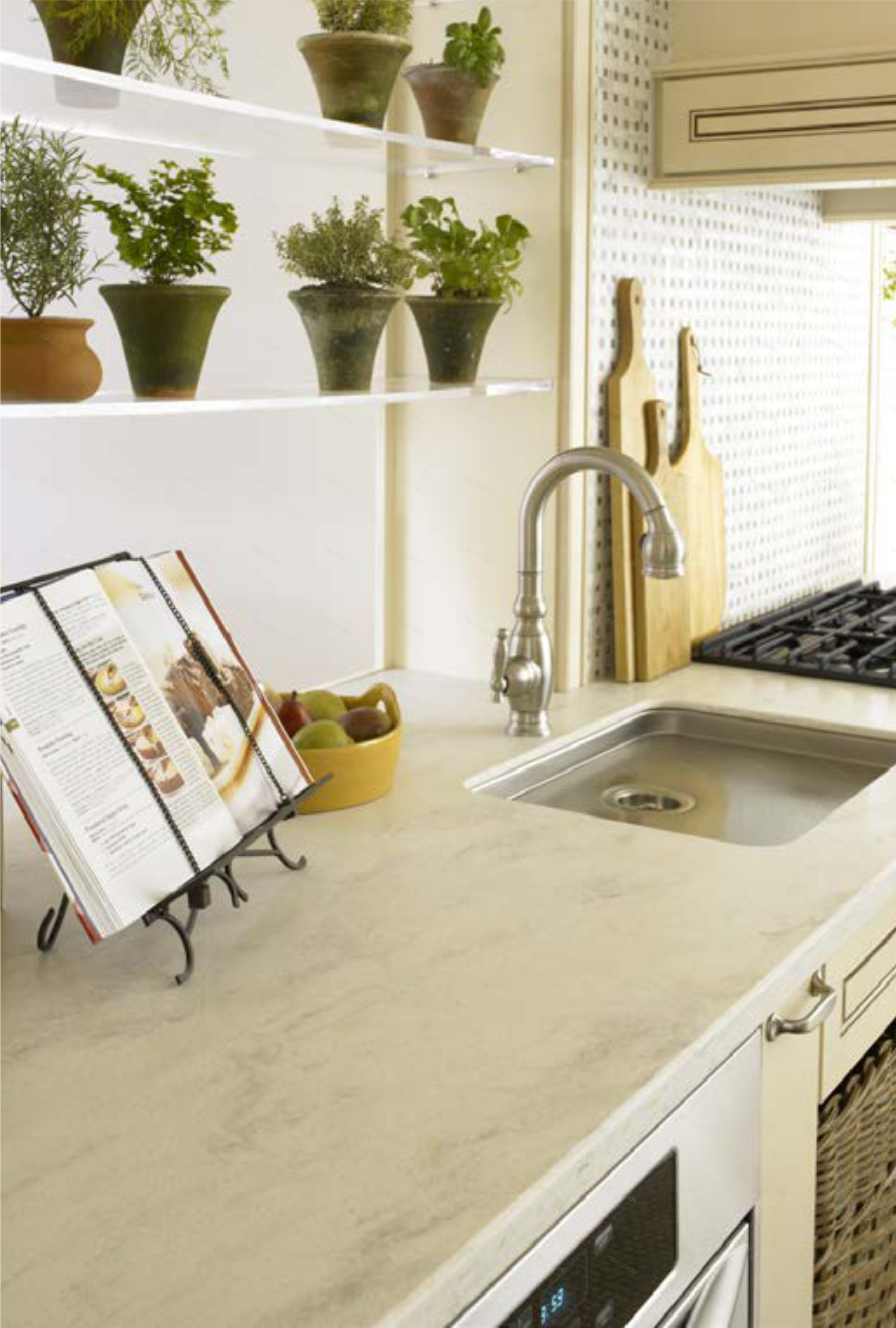
Choose quartz when low-maintenance, stone-like surfaces are the priority; consider acrylic solid surface when curves, integrated details, or refinishing options matter more. Use trivets under hot cookware and heat-producing appliances on both materials. Direct or prolonged heat can damage them, even when the surface tolerates normal kitchen use.
Granite and Marble
Granite and marble both offer natural variation, but their everyday care differs. Granite is generally less sensitive to common food acids than marble, which makes it easier to accommodate in a busy preparation area. Its color and pattern still vary from slab to slab, and some granites absorb liquids more readily than others. Select the actual slab and decide whether an impregnating sealer is needed for that stone.


Marble is often chosen for its veining and softer visual character. Lemon juice, vinegar, and other acidic ingredients can etch its surface, leaving dull marks even when the stone has been sealed. It suits a kitchen where the owner accepts this change in appearance and will wipe spills promptly. Use a chopping board for food preparation and a neutral cleaner for routine care.
For either stone, plan the visible veining and seam positions before cutting. Use a trivet under hot pans. A sealer can reduce liquid absorption and staining, but it does not make stone stain-proof or prevent acid etching in marble.
Sintered Stone
Sintered stone combines low absorption with resistance to heat and everyday stains in products designed for countertops. Some brands list near-zero porosity, easy cleaning, and high-temperature resistance among the features of their countertop products. Large slabs can create a broad, uninterrupted pattern, and using a coordinated finish on the worktop, island, and backsplash can connect the kitchen visually.

This makes sintered stone worth considering when you want a large stone-like surface and relatively simple daily cleaning. Protect exposed edges from heavy impacts, and have sink openings and overhangs detailed by an experienced fabricator. The edge profile, support, and care instructions should follow the selected product; a durable surface still needs a well-made countertop.
Stainless Steel
Stainless steel provides a nonporous surface that can be wiped clean after food preparation. A fabricated countertop can include a welded sink and upstand, reducing joints around the wet area. Its heat tolerance and functional appearance make it a useful option for frequent cooking, especially when easy cleaning matters more than maintaining an unmarked surface.


Expect the appearance to change with use: fine scratches accumulate, water left to dry can leave marks, and heavy impacts may cause dents. A brushed finish can make some marks less prominent than a mirror finish. Use a chopping board, wipe the surface dry, and protect it from hot cookware as directed by the countertop supplier. When comparing samples, look at the finish, corners, and sink connection.
Before ordering, agree on seam positions, sink details, and the finished countertop layout. These choices affect cleaning and appearance across all four material families. The table below separates quartz from acrylic solid surface, and granite from marble, so their practical differences remain visible.
| Material | Heat and staining | Seams and repair | Routine care |
| Engineered quartz | Resists everyday staining; protect from hot pans and prolonged heat | Slab joints can remain visible; chips and cracks need specialist assessment | Usually no sealing; wipe spills and use a suitable mild cleaner |
| Acrylic solid surface | Nonporous; use trivets and protect from heat-producing appliances | Color-matched joints; curves possible; some damage can be refinished | Clean and dry after use; follow the finish-specific repair method |
| Granite | Generally less acid-sensitive than marble; absorption varies; use trivets | Visible slab joints; choose the actual slab and vein layout | Neutral cleaner; use an impregnating sealer where the stone needs one |
| Marble | Acid can cause dull etch marks; sealing does not stop etching | Slab joints and natural variation; etched areas may need refinishing | Wipe spills promptly; neutral cleaner; sealing only where appropriate |
| Sintered stone | Countertop products offer heat and stain resistance; follow product care | Large slabs reduce joints; exposed edges need impact protection | Simple daily cleaning; use the cleaner specified for the finish |
| Stainless steel | Nonporous and heat-tolerant; watermarks and scratches can show | Welded sink details possible; repair appearance depends on the finish | Use a chopping board; clean and wipe dry; avoid unsuitable abrasives |
Wall Materials for Splashes and Easy Cleaning
Behind a cooktop, choose a surface that tolerates the expected heat and can be wiped free of grease. Behind a sink, focus on splashes and the sealed junction with the countertop. These needs overlap, but the appliance instructions determine the required clearance and suitable wall construction around the heat source.
Smooth glazed tile is a practical starting point for frequent cooking because the face is easy to wipe. Raised decorative textures take more effort to clean, and tile joints add grout lines that also need attention. Larger tiles can reduce the number of joints, although they do not remove the need for sound grout and sealed junctions.


Stone brings natural veining to the wall and can continue the visual language of a stone countertop. Marble needs particular care around acidic splashes; stone that readily absorbs liquid may benefit from an appropriate impregnating sealer. Choose it when the appearance is worth the additional care.
Stainless steel offers a continuous, wipeable backsplash with relatively few joints. It suits a functional kitchen or a deliberate metal accent, but watermarks and grease films can remain visible until wiped away. A simple profile with few ledges is easier to clean than an elaborate folded detail.
Flooring for Water Exposure and Everyday Comfort
Porcelain tile has low water absorption and is a useful starting point for kitchens where spills are common. First choose a floor product whose declared use includes the expected wet conditions. If grease regularly reaches the floor, include that contamination in the selection discussion. A matte appearance alone does not establish slip resistance.
Among products suited to those conditions, compare how easily the surface can be cleaned. Deep texture may trap dirt, while a smoother face is easier to wipe but must still have suitable slip-performance information. Use a sample to judge texture and comfort underfoot, and remember that grout lines add cleaning work. Low absorption in the tile does not make the whole floor assembly waterproof.
Natural stone flooring offers variation that can connect the kitchen with adjoining rooms, but the surface treatment affects both appearance and maintenance. Where the stone readily absorbs liquids, apply a suitable impregnating sealer to a clean, dry surface according to its instructions. This reduces staining risk; it does not prevent marble etching or establish slip resistance. Clean with a neutral product and remove spills promptly.
Solid wood has a natural feel underfoot, while engineered wood uses a layered construction that generally limits movement more than solid boards. Both can create visual continuity with a dining or living area, but neither should be treated as waterproof. Wipe spills immediately, avoid wet mopping and steam cleaning, and address leaks quickly. If standing water is likely to be a recurring problem, start with a flooring option intended for that exposure rather than relying on careful cleaning alone.
When comparing flooring, consider the step into the adjoining room and whether doors and appliances still have enough clearance. This is especially useful when the kitchen continues into an open-plan living space. Keep transitions easy to clean and comfortable to walk across.
Cabinet Cores and Moisture Protection
The core is the board that forms the cabinet structure or door beneath its decorative surface. It influences strength, how fittings are attached, and how the panel responds to moisture. The face controls much of the visible appearance and everyday cleaning. Compare the core and finish separately, because the same surface design can cover different boards.
Particleboard is made from wood particles bonded into a panel and is often a budget-conscious cabinet choice. Ordinary grades are intended for dry conditions; moisture-resistant grades are designed for more humid use. For example, EGGER distinguishes P2 boards for dry interiors from P3 boards for humid conditions. Neither description means that exposed edges can remain in standing water.


MDF uses fine wood fibers to form a uniform board, making it useful for routed door profiles and painted finishes. Choose a moisture-resistant version where the application calls for it, and protect the cut edges. Its smooth surface is a design and fabrication advantage, not evidence that every MDF panel handles moisture in the same way.
Plywood consists of bonded veneer layers and can be a useful cabinet core where a layered construction is preferred. The quality of the layers and the bond still matter: visible voids at cut edges or an unsuitable bonding specification are reasons to examine the product more closely. It should be selected by its declared quality and moisture suitability rather than by the plywood label alone.
Edge-glued solid wood preserves natural wood grain and is suitable when that material character is part of the design. It also responds to humidity, so door and panel construction must allow for movement. Protective finishing and prompt attention to spills remain necessary, including at joints and exposed edges.
Emissions and Material Information
For indoor air quality, compare the actual panel and finish, not a simple ranking of wood types. Ask for a recent emissions report that identifies the product, test method, and result, and compare results obtained by the same method. Plywood, MDF, and particleboard use adhesives whose formulations vary. Edge-glued solid wood also includes adhesive and usually a finish, so its name alone does not establish a low-emission cabinet. Choose documented products that meet the requirements of the intended market.
For preliminary budgeting at comparable dimensions, thickness, emissions performance, moisture requirements, and finish, use this high-to-low guide: edge-glued solid wood, plywood, MDF, then particleboard. Actual quotations can change that order, so compare equivalent finished cabinets rather than board prices alone.
At the sink cabinet, seal exposed cut edges and pipe openings with a system suitable for the board, wipe up leaks promptly, and keep plumbing accessible for inspection. Follow the appliance instructions for steam protection beside a dishwasher. These local details protect vulnerable parts of the cabinet; a moisture-resistant core still needs them.
Cabinet Finishes and Everyday Care
PVC thermofoil uses a plastic film bonded over a door, often following a shaped MDF profile. It offers plain colors and wood-effect designs with a wipeable face. It is useful when you want a shaped door with a consistent decorative surface. Keep concentrated heat and steam away from vulnerable edges, and use any heat protection required by the cabinet and appliance manufacturers.
Lacquered doors offer painted color and a choice of gloss levels, which helps coordinate the cabinets with the rest of the room. The coating can cover shaped profiles, but knocks can chip an edge and repairs may remain visible if color or sheen does not match. Clean with a soft cloth and a suitable mild cleaner, and inspect an actual finished door before choosing the color.
Melamine resin-impregnated decorative paper is fused to a board to produce a ready-finished surface. The finished panel includes both that facing and its core; the facing itself is not a separate type of structural board. It is a practical option for straightforward cabinet and door surfaces, with many colors and printed textures. Check the edge finish and protect cut openings, where the core can still be exposed to moisture.

With comparable cores, door sizes, and quality requirements, use lacquer above PVC thermofoil, followed by melamine, as an initial budget guide. Confirm the order with equivalent quotations. Compare complete door samples, including the edges and back, and judge the color under the kitchen lighting.
Combining Materials Around Your Priorities
Cooking frequency, an open layout, and a limited budget can all apply to the same kitchen. For example, a household that cooks daily in an open-plan space could choose a countertop for easy cleaning, a simple tile or steel backsplash near the cooktop, and cabinet colors that continue into the living area. Keep spending on moisture protection and sound installation, then control decorative costs through simpler door profiles, standard colors, and a restrained mix of finishes.
Place the shortlisted countertop, backsplash, flooring, and cabinet samples together under the planned lighting. Then compare quotations using the same dimensions and scope, including fabrication, hardware, delivery, and installation. This gives you a clearer view of both the finished appearance and total cost.
Conclusion
Choose kitchen materials by the trade-offs you will live with: cleaning effort, heat exposure, visible wear, moisture care, appearance, and cost. Compare the specific materials within each category, then coordinate the surfaces you will see together. A good choice should make daily use manageable as well as support the design.
FAQs
Which is better for curves and inconspicuous seams, quartz or acrylic solid surface?
Acrylic solid surface is usually the more suitable starting point for these details. Products designed for thermoforming can create curves, and color-matched adhesive can make joints less noticeable. Quartz is fabricated from slabs and generally retains visible joints. Check the proposed shape and color with the fabricator, because patterned surfaces can still reveal a seam.
Does sealing stop marble from etching?
No. An impregnating sealer reduces liquid absorption and can help resist stains. Acid etching is a reaction with the stone itself, so lemon juice or vinegar can still leave a dull mark. Wipe acidic spills promptly and use a neutral cleaner; etched areas may need professional refinishing.
What should I look for in a sink cabinet core?
Look for a panel declared suitable for the expected moisture exposure, with protected edges and pipe openings. Moisture-resistant particleboard or MDF and suitably specified plywood can all be considered; the complete cabinet detail matters. Keep plumbing accessible and repair leaks promptly. No wood-based cabinet should rely on a moisture-resistant label to tolerate prolonged standing water.
Explore IDEAFUSION’s products and materials for kitchen applications, then request samples or contact a consultant to discuss your needs, budget, and preferred style.


