


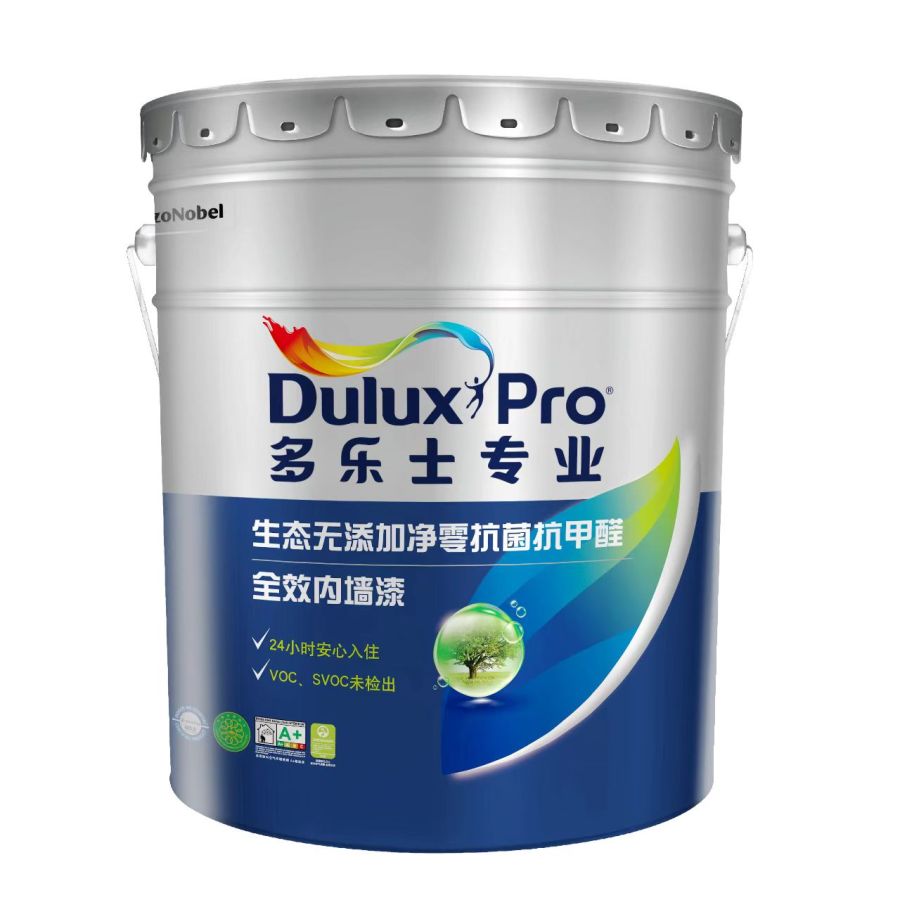
Additive-Free Anti-bacterial Anti-formaldehyde All-in-One Latex Paint




Details
Introduction: Dulux Professional Ecological Zero-Added Antibacterial & Formaldehyde-Abating All-in-One Interior Paint adopts revolutionary net-zero technology: during formulation and production, no formaldehyde, benzene or other volatile organic compounds (VOCs) and semi-volatile organic compounds (SVOCs) are intentionally added. After application, the SVOC emission level tends towards zero. Safe for occupancy as soon as 24 hours after painting. Meanwhile, the product uses formaldehyde-reducing and antibacterial technology to absorb and purify harmful substances in indoor air, ensuring a safe and healthy indoor environment.
Use: Suitable for decoration and protection of various interior walls such as plasterboard, gypsum board, etc.
Sheen: Matte
Main ingredients: Lead-free pigment, acrylate copolymer, water, additives
Volume solids: White 40% (nominal)
Drying time: Standard single-coat thickness (25°C, 50% relative humidity)
Touch dry: 0.5–1 hour
Recoat: 2–3 hours
Drying time will vary with temperature and humidity changes
Film thickness
Wet film: 80 microns
Dry film: 24 microns
Color: White or custom color
Pack size: 15 L
Storage: Store in a cool, dry place, protect from freezing; shelf life: 36 months
Advantages:
Excellent environmental performance, VOC and SVOC levels tend towards zero
Three international certifications: Eurofins IAC Gold, UL GREENGUARD Gold, and French A+ indoor air emission standard
Scientifically removes formaldehyde, efficient and long-lasting
Safe and effective, lasting antibacterial performance
Scrub resistance for easier cleaning
Excellent mildew resistance
Typical paint system
Primer: Dulux Professional Ecological Efficient Interior Primer P7106 (1 coat)
Topcoat: Dulux Professional Ecological Zero-Added Antibacterial & Formaldehyde-Abating All-in-One Interior Paint P7881 (2 coats)
Attention
Surface preparation:
Surfaces to be painted must be completely free of grease, dust, and loose matter. New walls must be fully dry. The moisture content of the substrate (or putty) must be less than 14%, and the pH value must be lower than 10. Unpainted wood or ferrous metal should be properly primed first.
New walls:
1. Newly built concrete walls must cure for 30 days before applying putty.
2. Putty must not be too soft. After the putty is completely dry, sand smooth with fine sandpaper and dust off.
Old walls:
1. When repainting previously painted walls, use a scraper to remove peeling paint and sand to remove all loose material and flaking paint film. 2. Fill wall defects with appropriate putty.
Moldy walls:
1. Use a scraper and sandpaper to remove mold stains.
2. Apply a suitable mold wash once, rinse promptly with clean water, and let dry completely.
Usage suggestions:
1. Read the instructions before application.
2. Stir the paint thoroughly after opening the can.
3. If necessary, add an appropriate amount of water according to the instructions; do not over-dilute.
4. Avoid overloading the brush or roller with paint during application.
5. Do not pour diluted paint back into the original container.
6. Use opened product as soon as possible.
Application recommendations:
Theoretical spreading rate: Theoretically, 1 liter of this product can cover 11–13 square meters per coat. Actual coverage will vary depending on application method and surface roughness.
Application tools: Brush, roller, conventional spray, or airless spray.
Dilution method: Depending on ease of application and temperature, up to 20% clean water may be added; do not exceed 20%.
Brush or roller: Typically add 1 part water to 5–10 parts paint (10–20%).
Conventional spray: Typically add 1 part water to 5–10 parts paint (10–20%).
Airless spray: Generally, no additional water is recommended.
Spraying suggestions:
Conventional spray: Most equipment can achieve satisfactory results.
Airless spray: Typical settings: minimum working pressure 140 kg/cm² (2000 psi), nozzle size 0.58 mm (23 thou), nozzle angle 65°.
Cleaning: Clean tools immediately with clean water after use.
Application precautions: Do not sand the final topcoat. If the first topcoat is sanded, ensure the final topcoat uniformly covers it. Do not apply when substrate temperature is below 10°C or ambient humidity exceeds 85%. When applying dark or vivid colors, control the dilution ratio within 5% or do not dilute, and increase the number of coats appropriately until a satisfactory result is achieved (refer to the dark/vivid color application guide).
Safety, health and environmental notes:
Keep paint cans tightly closed and out of reach of children.
Wear an appropriate dust mask when sanding surfaces.
Ensure good ventilation during application and drying.
Do not inhale paint vapors or spray mist.
When spraying in poorly ventilated areas, wear appropriate respiratory protection. All respiratory equipment must meet (NIOSH/MSHA) approved standards.
Keep this product away from food and beverages.
Wear protective gloves and eyewear when using paint.
In case of eye contact, rinse immediately with plenty of water and seek medical advice.
If paint gets on skin, first wipe off the paint, then wash with soap or a suitable cleanser and water.
If swallowed, seek immediate medical attention and show this container or label.
When transporting paint, be careful to keep the can upright with the lid facing up.
In case of spillage, cover with sand or soil, collect and dispose of properly.
Do not pour paint into sewers or drains.
Dispose of paint waste in accordance with local environmental standards.


